
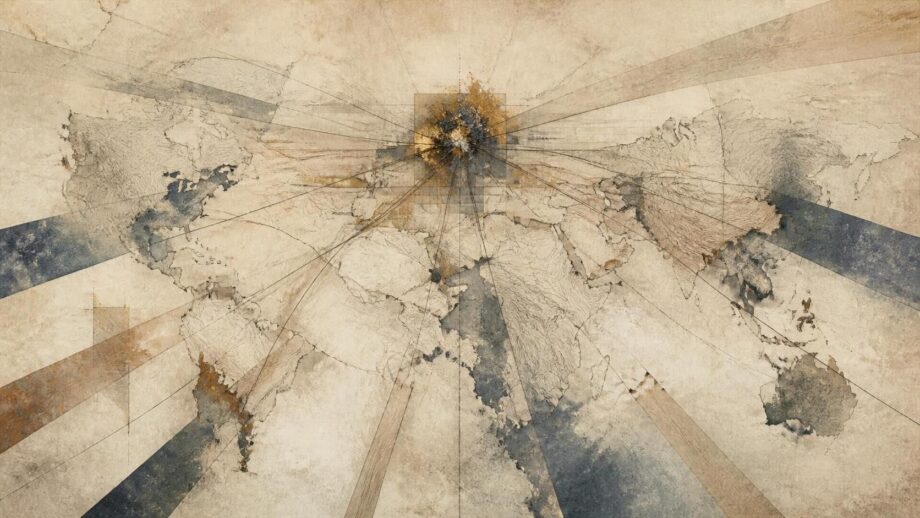
A historical argument about concentrated power, coercive expansion, and its reproduction
Abstract
“The Vacuum of Power” names a durable, interconnected pattern in which concentrated power over resources becomes power over people’s conditions of life. The argument developed here is that Western Europe’s overseas expansion from the late fifteenth century marked a decisive planetary inflection: conquest, coerced labor, resource extraction, political rule, Christian legitimization, and the construction of difference became mutually reinforcing instruments of dominance. The argument does not depend on a single, continuously coordinated ruling group or an unchanged plan. Its claim is that identifiable aims and repeated investments—in conquest, appropriation, labor control, conversion, and rule—established an order whose methods and beneficiaries changed while its concentration of power reproduced itself. The historical record supports this account strongly, while also requiring care about the origins of empire, the timing of Europe’s economic ascendancy, and the varied roles of colonized societies and local actors.
The argument
The claim is not simply that inequality has existed for a long time, nor that several separate problems—economic, political, and cultural—happen to overlap. It is that these dimensions form a single historical process. Control of resources enables rule; rule organizes access to resources and labor; cultural and religious claims help justify whose authority counts and whose lives may be governed. Together, these capacities can constrain the choices and security of populations on a vast scale.
The term “oligarch” identifies concentrated command over the means by which collective life is organized—not wealth alone. It refers to an enduring imbalance in who can acquire resources, shape institutions, direct labor, define legitimate authority, and protect advantages over time. Actors need not be identical or united across centuries for oligarchic power to persist. Institutions, legal arrangements, commercial organizations, and inherited distributions of property can carry power forward even as particular rulers, firms, and ideologies change.
The term “Vacuum of Power” describes the human consequence of that pattern: the narrowing of material and political agency as resources and decision-making power concentrate. The squeeze is global because the relevant relations increasingly connect distant peoples and places; it is uneven because people encounter those relations from sharply unequal positions. It is not a claim that everyone experiences identical hardship or that every period brings deterioration in every measure.
Western Europe as a planetary inflection
The proposed starting point, around 1450, should be understood as a turning point in scale and connection—not as the origin of domination, empire, or exploitation in human history. Empires predate this period, including major powers outside Western Europe. What changes from the fifteenth century onward is that several western European states develop overseas systems of conquest and rule that connect distant continents through expanding maritime power, settlement, commerce, and coercion. By the early twentieth century, European empires had claimed territories across much of the world.
That expansion was not only an exchange of goods or a story of exploration. It involved the taking of Indigenous lands, enslavement and coerced labor, the seizure of resources, and the establishment of political control for the benefit of imperial powers and their commercial interests. Colonialism tied rule over people and territory to economic extraction; the forms differed by place and era, but European empires repeatedly pursued land, labor, commodities, and strategic advantage.
This is why the emphasis on investment and aims matters. The argument does not infer direction solely from a later unequal outcome. It points to actions and instruments designed to produce control: expeditions backed by rulers and patrons, conquest, colonial settlement, forced labor systems, imperial companies, and laws that enabled claims over land and people. In the case of Portugal, a 1455 papal bull explicitly authorized the king to “invade, search out, capture, vanquish and subdue” non-Christian peoples and lands. That document is evidence of an articulated political-religious authorization for conquest—not, by itself, proof that every European actor shared one master plan.
Rule, theology, and xenophobia as a braid
In this account, political rule, Christian theology, and the construction of outsiders as inferior or alien do not operate as independent factors. They can reinforce one another. Religious language could cast conquest as a duty of conversion or salvation; legal and political authority could translate that claim into control over territory and people; distinctions between Christian and non-Christian, civilized and “uncivilized,” or ruler and subject could make unequal treatment appear warranted. Colonial authorities could present domination as both material advantage and moral purpose.
This braid is visible in the legal-religious doctrines used to claim lands and authorize subjugation. The fifteenth-century Doctrine of Discovery, for example, drew on papal declarations that granted Christian rulers authority to invade non-Christian lands, impose Christianity, and claim resources. Its later significance lies not only in the language of the original documents but in the way legal concepts associated with discovery and sovereignty were carried into later colonial law and Indigenous dispossession.
The point is not that theology alone caused empire, or that every religious actor served the same interests. Nor is it that xenophobic distinctions were fixed and identical across centuries. It is that these ideas could help make coercive arrangements legible and legitimate, and could be adapted when older justifications lost force. Religious mission, civilizing claims, and racial hierarchy could change in emphasis while continuing to serve forms of rule and appropriation. The historical argument is strongest when it treats ideology as part of how power operated—not as mere rhetoric, and not as a complete explanation by itself.
Reproduction across changing eras
The claim of persistence does not require unchanged institutions. Systems endure by adapting. Colonial instruments of rule could become embedded in law and administration; legal classifications and coercive practices could survive formal political transitions; and forms of authority developed in colonial encounters could become part of later state systems. Scholarship on colonial legacies documents the persistence and institutionalization of such instruments, including the survival of some colonial-era laws and the influence of colonial encounters on concepts of territorial sovereignty.
Economic historians likewise find that colonial rule shaped institutions and power relations in ways that could persist after independence. The evidence does not support one uniform colonial legacy: outcomes varied with the identity and methods of the colonizing power, local conditions, and the institutions and social forces already present. That variation can be part of the explanation of how domination was implemented; it does not erase the existence of the projects or the durable advantages they created.
A crucial implication follows: uneven success does not negate sustained direction. An imperial project can meet resistance, fail in particular places, or change its techniques while still showing recurring investments toward control. Competing imperial powers can fight each other while participating in similar projects of expansion. Local elites can collaborate, negotiate, or resist without making imperial coercion a jointly authored or evenly shared undertaking. The central evidentiary question is therefore not whether every actor acted in concert, but whether repeated objectives, institutions, and material commitments created and reproduced a durable structure favoring concentrated power.
The contemporary connection
The present-day “vacuum” is not established by historical continuity alone; it must also be observed in current distributions of wealth, opportunity, and power. The World Inequality Report 2026 estimates that the global top 10% own three-quarters of global wealth, while the bottom 50% hold 2%. It also describes inequality in human-capital access, climate responsibility, and international financial relations. Those findings demonstrate extreme contemporary concentration and interdependence. They do not, on their own, prove that each present inequality was caused by a specific colonial policy; that requires tracing the particular mechanisms and histories involved.
The historical and contemporary claims are therefore related but not interchangeable. The first concerns a long-run system of expansion, coercion, and institutional reproduction; the second concerns the present distribution of wealth and the constraints people face. The thesis connects them by asking how earlier forms of concentrated power were transformed—not merely whether today’s inequalities look like those of the past. The “vacuum of power” names the experience of living within the resulting order, while the “oligarchic” element identifies the recurrent concentration of capacity to shape that order.
Scope and qualification
This argument does not claim that Western Europe invented domination, that every society followed the same path, or that the world’s empires were morally or historically equivalent. It identifies Western Europe’s overseas expansion as a decisive inflection in the creation of a particular planetary order. It also recognizes that historians debate when and why Europe’s economic divergence from major Asian economies occurred. Some accounts locate important divergence before industrialization; others emphasize a later acceleration, especially after the eighteenth century. Colonial expansion is a major part of the debate, but the timing and relative weight of its causes remain contested.
These qualifications constrain particular causal claims; they do not dissolve the larger thesis. The fact that earlier empires existed does not make the scale and form of European overseas expansion unexceptional. The fact that outcomes varied does not turn repeated projects of conquest and extraction into neutral events. And the fact that today’s institutions have multiple sources does not make colonial histories irrelevant to how some of those institutions and inequalities took shape.
Conclusion
From the late fifteenth century, Western European powers drove a decisive expansion of global systems of coercive rule and resource appropriation. They repeatedly joined political authority, religious legitimization, and the construction of human difference to the control of land, labor, and wealth. Those projects were pursued through identifiable aims and sustained investments; they generated institutions and distributions of power capable of outlasting particular rulers and formal empires. Their methods and beneficiaries changed, and their effects varied, but that variation does not neutralize the recurring direction of the projects. Vacuum of Power names the continuing problem of concentrated power over the conditions of life, now operating through a world historically shaped—but not exclusively determined—by that expansion.
References
Acemoglu, D., Johnson, S., & Robinson, J. A. (2001). The colonial origins of comparative development: An empirical investigation. American Economic Review, 91(5), 1369–1401. https://doi.org/10.1257/aer.91.5.1369
Davenport, F. G. (Ed.). (1917). European treaties bearing on the history of the United States and its dependencies to 1648 (pp. 20–26). Carnegie Institution of Washington.
Go, J. (2024). Reverberations of empire: How the colonial past shapes the present. Social Science History, 48(1), 1–18. https://doi.org/10.1017/ssh.2023.37
Nowell, C. E. (n.d.). Western colonialism. In Encyclopaedia Britannica.
Our World in Data. (2025, July 30). A century ago, around half of today’s independent countries were European colonies.
Pomeranz, K. (2000). The great divergence: China, Europe, and the making of the modern world economy. Princeton University Press.
World Inequality Lab. (2026). Global economic inequality. In World inequality report 2026.

1 thought on “The Vacuum Of Power”
Comments are closed.