
I won’t bother couching this one in a nice story about going grocery shopping.
Sometime in 2012, I wrote an article that served an analogy for why relying on Google and letting them profile your data was a horrible invasion of privacy, generally A Bad Idea, and ultimately would make it impossible for humans to engage in markets without trading away their privacy, not to mention their digital dignity and a trove of utterly and absolutely invaluable personal data, behavior, and habits. Few listened. Time passed, and as usual, those forecasts came to pass (they usually do, 87%^ accuracy over 30 years, folks).
Today, the discourse has advanced. Behavioral, Psychological, and Sentiment profiling are passe, if you’re not profiling your customers yourself, you have one or more companies doing this in some manner on your behalf. The ‘click through’ or ‘shrink-wrapped’ contract is, according to most business, perfected; today all customers routinely:
– Hand over their right to redress outside of any issue not required by law,
– Give up their right to privacy and freedom from behavioral, psychological, and sentiment profiling,
– Waive their right to legal process and indemnify the company from liability,
– Must cover and manage liability of protecting business asset access and misuse, and more.
Effectively, consumer’s in the United States cannot engage with a company without first indemnifying it from most if not all redress.
It is utterly usual today. So much so that a company choosing not to do so can make the news cycles. They strip consumer protections that might otherwise require them to raise their ethical or legal bars. They will claim and decry ‘costs’ to hide all this under it.
Insult to injury, these days, many companies “play” by intentionally including terms that are cultural breaches – just keeping it community, of course (courtesy of infotrack.com, sic):
- Amazon Lumberyard’s zombie-apocalypse exception: Its terms said a restriction wouldn’t apply if the CDC certified a widespread infection that reanimated corpses and threatened civilization.
- GameStation’s “immortal soul” clause: On April Fools’ Day 2010, the UK retailer tucked a clause into checkout terms claiming customers agreed to hand over their souls. It was a prank, and the company later said it wouldn’t enforce it.
- Europol Wi-Fi’s firstborn clause: In a public Wi-Fi experiment, users were asked to agree to assign their first-born child “for the duration of eternity.” Six people accepted; the clause wasn’t meant to be enforced.
- PC Pitstop’s hidden $1,000 reward: An antivirus company buried a promise of $1,000 for the first person to spot it in its terms. Someone eventually did—after thousands of downloads.
- iTunes and weapons development: Its terms included a prohibition on using the software for activities such as developing nuclear, missile, chemical, or biological weapons—an oddly dramatic warning for a music player.
But the truth of their motivation and intentions are realized when you look at the estimated revenue.
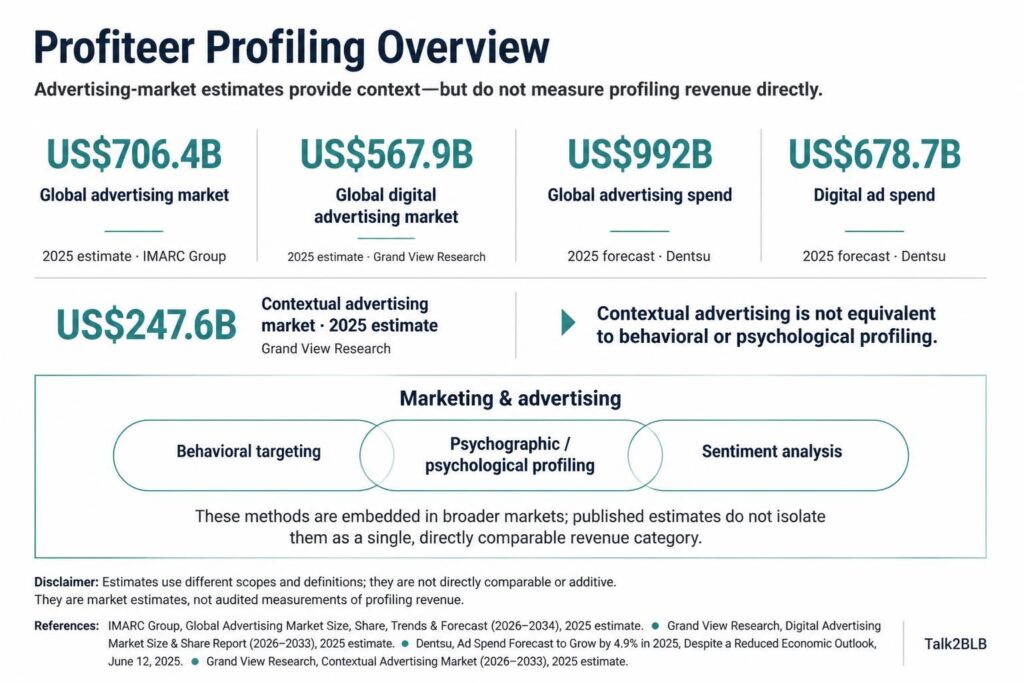
The buckets around which this industry is reported routinely refuse to specify beyond top line items; traditionally, this behavior is common when business methods in operation will not positively bear close scrutiny.
Their posture also stands to reason given what we know and can see happening with Large Language Models, Large Multi-mode Models, and related “artificial intelligence” technology push underway. Things like plausible deniability, leaning against discovery and consumer protections, and more and more often, dark use patterns demonstrate that all industry and domains are straining in their efforts to keep this pipeline of increasingly valuable profiling flowing under the tattered and increasingly insufficient gauze of plausible deniability before inquiry and law.
The valuation of this profile profiteering is difficult to underestimate. It is clear from the above alone that the global economy is “all in” on continuing these practices, regardless the negative outcomes to consumers. It is equally clear that dark pattern use, abuse of terms of service, and copious layers of plausible deniability are eagerly replicating the examples set by the national administration – it’s ok so long as you can continue getting away with it, denial and legal blockading are the new open water piracy, which is an irony for those of us who see it.
There is no doubt remaining – business directly opposes consumers on the matter of personal data privacy, privacy protection as mandate, digital dignity as philosophy, etc. And at the heart of this? The quieter, uglier truth that it seems so much of our nation wishes to continue denying:
The United States of America has a real problem with consent – their understanding of it stops the moment someone says, “No.”
References
- Dentsu. Ad Spend Forecast to Grow by 4.9% in 2025, Despite a Reduced Economic Outlook. June 12, 2025. https://www.dentsu.com/news-releases/ad-spend-forecast-to-grow-by-four-point-nine-percent-in-2025-despite-a-reduced-economic-outlook dentsu.com
- European Commission. (2023). Digital fairness: Commission and consumer protection authorities launch a sweep of websites to detect online consumer manipulation. https://commission.europa.eu/topics/consumers/consumer-rights-and-complaints/enforcement-consumer-protection/sweeps%5C_en
- Federal Trade Commission. (2014). Data brokers: A call for transparency and accountability. https://www.ftc.gov/reports/data-brokers-call-transparency-accountability-report-federal-trade-commission-may-2014
- Federal Trade Commission. (2022). Bringing dark patterns to light. https://www.ftc.gov/reports/bringing-dark-patterns-light
- Grand View Research. Digital Advertising Market Size & Share Report, 2026–2033. https://www.grandviewresearch.com/industry-analysis/digital-advertising-market-report
- Grand View Research. Contextual Advertising Market (2026–2033). https://www.grandviewresearch.com/industry-analysis/contextual-advertising-market-report
- IMARC Group. Global Advertising Market Size, Share, Trends & Forecast (2026–2034). https://www.imarcgroup.com/global-advertising-market imarcgroup.com
- Luguri, J., & Strahilevitz, L. J. (2021). Shining a light on dark patterns. Journal of Legal Analysis, 13(1), 43–109. https://doi.org/10.1093/jla/laaa006
- Mathur, A., Acar, G., Friedman, M. J., Lucherini, E., Mayer, J., Chetty, M., & Narayanan, A. (2019). Dark patterns at scale: Findings from a crawl of 11K shopping websites. Proceedings of the ACM on Human-Computer Interaction, 3(CSCW), Article 81. https://doi.org/10.1145/3359183
