
The unease about life after 2020 has a research-backed core. The evidence points not to one mysterious cause, but to lasting shifts in time perception and social connection—alongside real differences in how people recovered.
A post by Josh Rincon describes a disquiet many readers recognize: everything reopened, people returned to work and restaurants, events resumed—yet life still felt different. Years seemed to vanish. People felt disconnected, exhausted, and less alive.
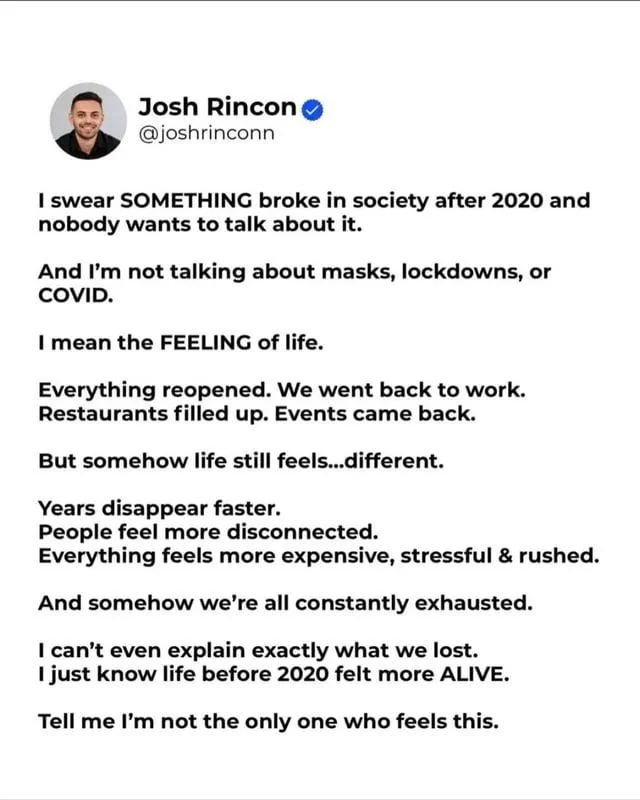
The striking part is not that thousands of replies prove everyone shares that feeling. They don’t. It’s that the post gives language to an experience that researchers have measured in more specific ways: time feeling altered, social contact changing, and the pandemic leaving different marks on different people. The evidence doesn’t establish one universal “after.” It does suggest that reopening the calendar was not the same as restoring everyone’s sense of continuity.
Time can drag in the moment and vanish in retrospect
“Time is moving slowly” and “the years are flying by” sound contradictory. They needn’t be. They can describe different experiences: the felt pace of the present, versus how much of the past remains distinct in memory.
A French longitudinal study followed the same participants through three lockdowns and again in 2022, when restrictions had ended. Among the 469 people who completed the final survey, 20.3% said time was passing considerably more slowly than usual, compared with 6.7% when asked about their pre-pandemic experience. The researchers also found that the participants’ memories of lockdown periods tended to make time seem faster than they had reported experiencing it at the time. That gap offers one possible explanation for the familiar sense that months once felt endless, while whole stretches of the subsequent years now seem to have disappeared. It is evidence from one French sample—not a measure of everyone’s experience, nor proof that the pandemic permanently changed time perception.
A separate U.S. study, using national Gallup survey data collected in spring 2021, found that people could feel rushed, feel time moving slowly, and experience days blurring together—sometimes in combination. Those reports were associated with pandemic-era pressures including economic strain, work-from-home demands, homeschooling, and household conflict. The implication is not that “time itself” changed, but that ordinary markers of time and routine were disrupted while many people were under strain.
Reopening restored activities, not necessarily connection
A return to restaurants, offices, and events can restore opportunities to be around people without restoring the depth or frequency of social ties. These are not the same measure: seeing people is different from feeling supported, close, or understood.
The OECD’s 2025 review of social connections across member countries found that in-person meetings with friends and family had been declining since 2006, while remote contact increased. It also found signs of deteriorating perceived connection in the years around the pandemic: across 22 European OECD countries, the share of people who said they never felt lonely fell from 59% in 2018 to 51% in 2022. The report cautions that overall rates of frequent loneliness were relatively stable, and that trends differ among groups and countries. This is not a simple story of the pandemic creating loneliness from scratch; it is evidence of a longer social shift, with some indicators worsening around the pandemic period.
Nor was every country’s experience the same. A Dutch study compared loneliness in 2020–2023 with long-term trends measured before the pandemic. In most of its analyses, loneliness had returned to or fallen below the projected pre-pandemic trend by the last observation. The author concluded that, in the Netherlands overall, the pandemic was more likely a major interruption than a lasting break in the trend—while noting exceptions, including for some younger adults. That finding matters: persistent distress is real for some people, but it should not be turned into a universal claim that social life everywhere remains permanently altered.
The most defensible reading
The post’s “feeling of life” is not a single scientific variable, and research cannot verify the inner experience behind every reply in a social-media thread. But the post connects several distinct things that studies can examine: disrupted time perception, blurred memories, changing patterns of social contact, and differences in who recovered and who did not.
Taken together, the evidence supports a sober interpretation: the pandemic was a profound disruption, and normal-looking routines returning did not mean that everyone felt restored. For some, it left a lasting sense of disorientation or disconnection; for others, measured loneliness or well-being moved back toward earlier levels. The thread’s replies are a meaningful sign that the post resonated with its readers—not a population survey, but not nothing.
Annotated sources
- Droit-Volet, Sylvie, et al. “Experience and memory of time and emotions two years after the start of the COVID-19 pandemic.” PLOS ONE 18, no. 9 (2023), e0290697. DOI: 10.1371/journal.pone.0290697. Longitudinal French study comparing participants’ reported experience of time during lockdowns with their later judgments outside lockdown. The sample and country limit how broadly the findings can be generalized.
- Andersson, Matthew, and Paul Froese. Research on pandemic-related time disorientation using national Gallup data collected in spring 2021; findings summarized in Baylor University’s report, “The Days Blur Together: Study Shows How the COVID-19 Pandemic Affected Perceptions of Time… and Our Mental Well-being” (February 2, 2024). Useful for the coexistence of feeling rushed, slowed, and temporally blurred, and their associations with stressors. The university report is a research summary, not the original journal article.
- OECD. Social Connections and Loneliness in OECD Countries. OECD Publishing, 2025. DOI: 10.1787/6df2d6a0-en. Comparative review drawing on official data; documents long-term declines in in-person contact and shifts in reported loneliness and support. Findings apply to the specified OECD datasets and populations, not to every country or individual.
- van Tilburg, Theo G. “Residual loneliness in the Netherlands after the COVID-19 pandemic: An application of the single interrupted time series design with pre-, peri- and post-pandemic observations.” Public Health 237 (2024): 238–244. DOI: 10.1016/j.puhe.2024.10.023. Uses two Dutch population-based studies and long pre-pandemic trend data to assess whether loneliness remained elevated after restrictions ended. Its conclusion is specific to the Netherlands and the study’s measures and follow-up period.
